Disinfection Services in Buffalo, NY
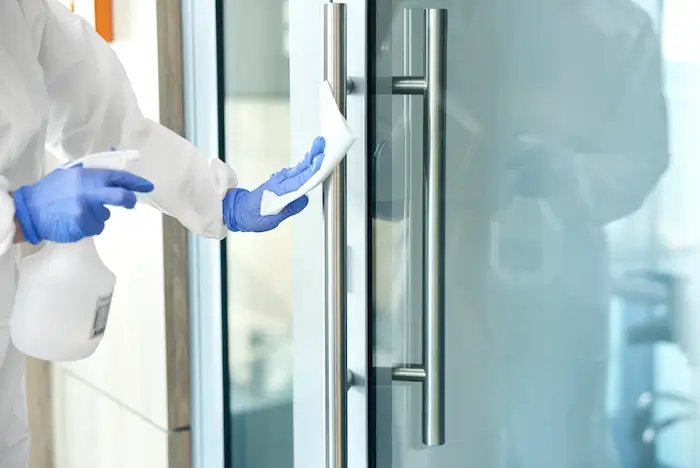
Disinfection is the step most often done wrong, because it looks like wiping. RTJ provides disinfection services across Buffalo and Western New York using EPA-registered products applied the way their labels actually require: on a cleaned surface, at the right concentration, left wet for the full contact time.
Cleaning and disinfecting are not the same thing
Cleaning removes soil. Disinfecting kills organisms. They are sequential, not interchangeable, and the order matters: a disinfectant applied over dirt or grease binds to the soil instead of the surface and the kill claim on the label no longer applies. Every RTJ disinfection visit cleans first, then disinfects.
Dwell time is the part everyone skips
Every EPA-registered disinfectant has a required contact time, the number of minutes the surface must stay visibly wet for the product to do what the label claims. It is commonly between one and ten minutes. Spraying a surface and wiping it dry ten seconds later is not disinfection; it is redistribution. Our cleaners are trained to the product label, and on surfaces that flash-dry quickly they reapply rather than pretending the first pass counted.
High-touch surfaces we treat
- Door handles, push plates, panic bars and door frames
- Light switches, thermostats and wall controls
- Elevator buttons, handrails and stair rails
- Shared desks, hot desks, counters and reception surfaces
- Keyboards, mice, phones, headsets and touchscreen kiosks
- Break-room appliance handles, faucets, dispensers and vending buttons
- Restroom fixtures, flush handles, stall latches and dispensers
- Conference tables, chair arms and remote controls
Where disinfection is worth scheduling
Recurring disinfection makes the most sense in space where the same surfaces are touched by many different people: medical and dental waiting rooms, dental and clinical treatment areas, schools and daycares, gyms and studios, customer-facing retail and service counters, shared conference and training rooms, and any office running hot-desking.
One-off and response disinfection
We also handle single-visit work: an outbreak in one department, a facility reopening after a closure, a space changing tenants, or a building that simply wants a reset before an inspection or an event. Tell us what happened and which areas are involved and we will scope it honestly, including telling you when a normal deep clean would serve you better than a disinfection call-out.
Products and safety
We use EPA-registered disinfectants appropriate to the surface and the setting, and we will tell you which product is being used on your account if you ask. Where a space needs a lower-toxicity approach (a daycare, a classroom, a room with sensitive occupants), we select accordingly rather than defaulting to the strongest thing on the truck. Cleaners use appropriate PPE and follow the manufacturer ventilation guidance.
Documentation
For clients who need to show their work (regulated facilities, schools, employers answering staff questions), we can document what was treated, when, and with which product. That record is often what an inspector or an insurer actually wants to see.
Schedule disinfection service
Call (716) 444-3622 or send a message with the type of facility, the approximate square footage and whether you need recurring or one-off service.
More about this service
How do you read an EPA registration number and a disinfectant label?
An EPA registration number identifies one specific tested formula, and it is printed on the front of the label as two or three number groups separated by hyphens.
The first group identifies the company that registered the formula. The second identifies the product itself. A third group, when it appears, means the same registered formula is being sold by another company under a different brand name, which is why two bottles with unrelated names on the front can carry identical claims. That number tells you more about what is in a building than the brand name does.
The rest of the label is worth reading before a product is bought, not after:
- Organism list. A disinfectant kills what its label names and nothing else. A product with a strong bacterial claim may say nothing about viruses, or the reverse.
- Sites of use. Most disinfectants are registered for hard, nonporous surfaces only.
- Dilution. Concentrates have a specific mix ratio. Mixing stronger does not work faster and can leave a residue that attracts soil.
- Kill claim versus contact time. One product can list different contact times for different organisms. The longest time on the list is the one that governs the job.
- Food-contact rinse. Some products require a potable water rinse after the contact time on any surface that touches food.
- Approved application methods. Wiping, mopping, coarse spray, immersion and fogging are listed separately, and a product not labeled for fogging should not be fogged.
Fogging, electrostatic spraying or hand wiping: when is each one appropriate?
Hand wiping is the correct method for high-touch surfaces, and spray application is for covering large areas of low-touch surface where wiping every square foot is not realistic. They solve different problems, and one is not a substitute for the other.
Wiping supplies friction, so the cloth carries the soil film away with it. Spray application supplies coverage and speed instead. An electrostatic sprayer charges the droplets so they are drawn toward surfaces and wrap partway around edges, but a droplet still cannot reach what is underneath an object or behind a closed drawer.
| Method | Best used for | What it will not do |
|---|---|---|
| Hand wiping | Door hardware, switches, handrails, desks, keyboards, restroom fixtures | Cover a large warehouse floor in a single shift |
| Electrostatic spray | Classrooms, gyms, waiting rooms, seating banks, open floor areas, vehicle interiors | Reach under objects, behind closed drawers or inside enclosures |
| Fogging | Sealed, vacated rooms where the product label specifically permits fogging | Work in an occupied space |
In practice the two are usually paired on the same visit: wipe the high-touch points, spray the broad surfaces, and keep both on one schedule so nothing falls between them.
What should a written disinfection record actually contain?
A useful disinfection record names the product, the areas and the method, so that a line item reading "disinfected offices" cannot be checked by anyone afterward.
A record detailed enough to hand to a third party includes:
- Date, arrival time and departure time
- The specific rooms, floors or zones treated, listed individually rather than as "the building"
- Product brand name and its EPA registration number
- Whether the product was ready to use or diluted, and at what ratio
- Application method for each area (wiped, mopped, electrostatic spray)
- The contact time the label requires, and confirmation that it was held
- Cleaner name or initials
- Areas skipped, and the reason (locked, occupied, equipment running)
- Anything deliberately not disinfected, such as electronics, upholstery or artwork
Keeping the skipped areas in the record matters more than it sounds. A gap you wrote down is a scheduling problem. A gap nobody wrote down looks like a false claim later.
What should you ask before hiring a disinfection contractor?
Ask which EPA-registered product will be used and for the label and safety data sheet that go with it, because most of the other answers follow from that one.
A short list worth working through before you sign anything:
- Which product, with its EPA registration number, and is it labeled for the surfaces in your building?
- What contact time does that label require, and how does the crew keep a surface wet for the full period?
- Which application method is planned for each area, and does the label permit that method?
- What is deliberately excluded, such as electronics, upholstery, artwork or food-contact surfaces that need a rinse?
- What does the written record look like, and can you see a sample before the first visit?
- Is the work performed by the company's own staff or subcontracted out?
- Current proof of insurance covering the work being quoted, which you should request directly from any contractor you are considering.
The first two questions do most of the sorting. A crew that works to the label can answer them without going to look.
Surfaces a disinfectant label does not cover
The sites-of-use line on a label rules out more of a building than people expect, and applying a product outside it either does nothing useful or causes damage.
Soft and porous items fall outside that language: upholstered seating, fabric partitions, mats and carpet. Fabric that needs attention gets hot water extraction rather than a chemical mist, which is handled as carpet and upholstery cleaning. Screens, keyboards and touch panels are wiped with the product applied to the cloth instead of sprayed at the device, because liquid running into a seam or a port is a repair bill.
Food-contact surfaces carry an extra step: where the label calls for a potable water rinse after the contact time, that rinse is part of the job, which is routine in supermarket and grocery store cleaning. Clinical spaces add sequencing and traffic rules on top of the chemistry, covered under hospital and medical facility cleaning.
Disinfection Services questions
More answers on the FAQ page.
What is the difference between cleaning, sanitizing and disinfecting?
Cleaning physically removes soil. Sanitizing reduces bacteria to a level considered safe by public health standards. Disinfecting kills a specified range of organisms named on the product label. Disinfecting only works properly on an already cleaned surface.
How long does a disinfectant need to stay wet?
It depends on the product. Most EPA-registered disinfectants specify a contact time between one and ten minutes. The surface must remain visibly wet for that full period, which is why our cleaners work to the label rather than to the clock.
Do you offer one-time disinfection after an outbreak?
Yes. Single-visit response service is available for a department, a floor or a whole facility. Tell us what happened and which areas were involved and we will scope it.
Is disinfection safe around children or sensitive occupants?
We select the product to fit the setting. Daycares, classrooms and rooms with sensitive occupants get lower-toxicity products and appropriate ventilation rather than the strongest available chemistry.
Is fogging or electrostatic spraying on its own enough to disinfect a room?
No. Sprayed droplets treat only what they land on, so shadowed surfaces, the undersides of handles and anything inside an enclosure get missed, and high-touch points still have to be wiped by hand. Fogging carries a further limit: it has to be a method the product label specifically permits, in a room that can be sealed and left empty for the re-entry period.
How long do people have to stay out of an area after it is treated?
That depends on the product and the method. Wiped surfaces in a normally ventilated room are usually usable again once the required contact time has passed and the surface is dry. Sprayed or fogged rooms stay vacated for the re-entry period printed on the label, with ventilation running. Work is scheduled around your occupancy wherever the label re-entry period allows.
Can we get the safety data sheet for the products used in our building?
Yes. Ask for the EPA registration number along with the SDS, since the number confirms exactly which formula the sheet describes. Employers commonly keep the SDS on file so that staff who ask what is being applied near their workspace get a real answer, and the sheet also carries the manufacturer's handling and first aid information.
Does disinfection replace regular janitorial cleaning?
No. Disinfection treats surfaces. It does not empty trash, vacuum, mop, restock restrooms or deal with the soil that builds up day to day. It works best as a defined step inside a regular cleaning program rather than as a separate purchase, so it is normally written into a commercial cleaning and janitorial schedule.
Do you disinfect after water damage or a sewage backup?
Those events are handled as restoration work rather than as a standard disinfection visit, because the material has to be extracted and the structure dried before any product is applied. Disinfecting a wet surface without drying the assembly first traps the problem inside the wall or floor. See water damage restoration for how that sequence runs.
Ready for a quote?
Call (716) 444-3622 or send us the details of your building.