
High Angle Dusting in Buffalo, NY
Everything above about ten feet gets skipped by a normal janitorial contract, and it accumulates for years. Then a sprinkler inspection flags it, or a warehouse light loses half its output, or dust falls onto a production line. RTJ handles high angle dusting across Buffalo and Western New York with the equipment and training the height actually requires.
What high angle dusting covers
- Structural steel, open beams, joists, trusses and deck
- Exposed ductwork, piping, conduit and cable tray
- Sprinkler heads, pipe runs and fire-protection components
- High-bay and warehouse light fixtures, reflectors and lenses
- Warehouse racking, upper shelving, mezzanines and catwalks
- HVAC diffusers, returns, unit heaters and fan housings
- Ceiling tiles, grid, soffits, ledges and upper wall surfaces
- Exposed-ceiling retail, restaurant and brewery interiors
Why it matters beyond appearance
Fire and inspection exposure
Accumulated dust and lint on sprinkler heads and structural members is a recognized fire-load and inspection issue. In some facilities a heavy build-up on a sprinkler head can affect how it performs. It is a common write-up during a fire-marshal or insurance inspection, and it is usually cheaper to clean than to explain.
Light output
A dusty high-bay fixture can lose a substantial share of its usable output while drawing exactly the same power. Cleaning fixtures and lenses is one of the least glamorous ways to brighten a warehouse, and it costs less than relamping.
Air quality and product protection
Overhead dust does not stay overhead. Vibration, door slams, forklift traffic and HVAC cycling shake it loose onto floors, inventory, work surfaces and open product. Facilities handling food, packaging, electronics or clean assembly usually find this is the real reason to schedule it.
How we do it safely
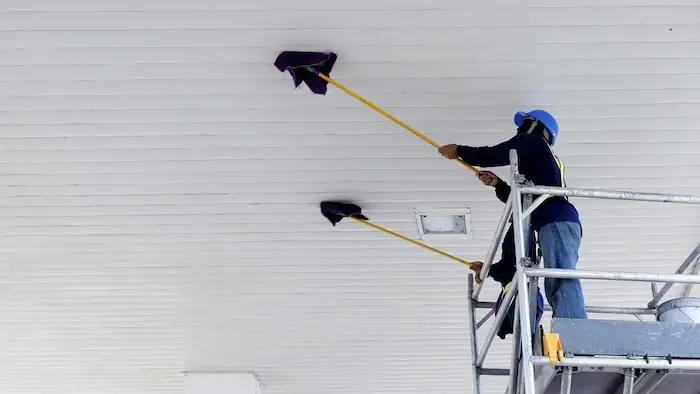
The method is chosen for the height, the surface and what is underneath. Extension poles with microfiber and dust-collection heads for lower and moderate heights, HEPA-filtered vacuum systems where dust must be captured rather than knocked down, and lifts or scaffolding where the work genuinely requires access at height. Where equipment or inventory sits below, we mask and protect it first and clean the floor after, because some dust always comes down.
Scheduling around production
Most high dusting is done outside production hours, during a shutdown, over a weekend, or zone by zone so only one part of the floor is offline at a time. For food and pharmaceutical facilities we work around your own sanitation and changeover windows rather than asking you to work around ours.
How often is it needed?
It depends entirely on the process below. A clean dry warehouse might go two or three years. A facility with fabric, wood, flour, powder or heavy forklift traffic can need it annually or more often. If nobody has looked in several years, the honest answer usually comes from a walkthrough with a light rather than from a schedule on paper.
Request high angle dusting
Call (716) 444-3622 or send a message with the facility type, approximate ceiling height and square footage.
More about this service
How can you tell overhead dust is overdue?
Overdue overhead dust gives itself away in specific ways you can see standing on the floor. One trick makes the reading easier: overhead lighting washes dust out because it comes from the same direction you are looking, so a light held low and angled up shows buildup that is invisible from directly below.
Signs that overhead surfaces are carrying years of accumulation:
- Fuzz or gray strands hanging from the underside of joists, cable tray, conduit or pipe. Dust that has grown long enough to hang did not arrive last month.
- A visible ridge of dust on the top edge of door frames, electrical boxes, ledges and pipe hangers.
- Fine grit landing on the top cartons of the highest rack position, or on tote lids, when nothing is stored above them.
- Loaded webbing in upper corners and truss intersections. Webs collect whatever is airborne, so heavy webbing is a dust reading, not a spider problem.
- A film that returns within days on a surface you wiped, with no change in the process below.
- Dark streaking on the ceiling around HVAC diffusers and return grilles, which shows air is moving dust along the deck.
Why access, not ceiling height, sets the schedule
Height decides the tool. Access decides the sequence and most of the time on site. A thirty foot deck over open floor is straightforward; the same deck over conveyor, racking and dock equipment is a different job, because getting a platform into position takes longer than the dusting itself.
What has to be sorted out before a date is set:
- Floor and route: slab condition, trench drains and covers, ramps, expansion joints, and whether a mezzanine or upper deck can carry equipment at all.
- Clearance: aisle width, turning room at the ends of racking, and door and opening heights along the travel path.
- Obstructions overhead: conveyors, dock equipment, low ductwork and anything that limits where a platform can be raised.
- Power and charging: where equipment plugs in, and where it sits between shifts.
- Anything that must be moved or emptied first, and who on your side can authorize moving it.
The practical effect is that a building is rarely dusted in a straight line. Areas reachable with poles from an adjacent floor or mezzanine get done in one pass, and areas that require pallets or fixtures to be moved get scheduled for whichever shift can move them.
Why compressed air blow-down is usually the wrong method
Blow-down moves dust; it does not remove it. Air hoses are fast and cheap, which is why they are still used, but the dust lands somewhere else in the same building and stays airborne long after the hose is shut off.
| Factor | Compressed air blow-down | Capture based dusting |
|---|---|---|
| Where the dust ends up | On floors, racking, product and machinery, and back overhead as it resettles | Removed from the building in the vacuum or on the head |
| Follow-up work | Everything below has to be recleaned, often more than once | Planned floor cleanup only |
| Air during the work | Heavy airborne load and poor visibility while the hose runs | Contained at the surface |
| Sensitive areas | Drives dust into open product, electrical panels and control cabinets | Surfaces can be worked individually and skipped where needed |
| Verifying the result | Hard to show anything was removed | Surface is wiped or vacuumed and can be inspected |
Air is still the right tool in narrow cases, such as blind pockets in a structure that no head can reach, and then only with capture running below and everything underneath covered.
How are sprinkler heads and pipe handled during dusting?
Sprinkler components are dusted, not serviced. The distinction matters because anything beyond gentle dust removal is fire protection work and belongs to your fire protection contractor.
- Heads are dusted gently by vacuum or a soft head. They are not scraped, wiped with solvent, coated or painted, and nothing is hung from the deflector.
- Sprinkler pipe is never used as an anchor, a handhold, or a place to rest tools.
- Damage, corrosion or a head that looks compromised is reported to you with a location so your fire protection contractor can look at it.
- Escutcheons, cover plates and concealed head covers are left in place rather than removed for cleaning.
- If a system is already drained or an area is impaired for other overhead work, that window is often the most efficient time to dust the same area, since the space is already cleared.
The same rule applies elsewhere overhead. Fixtures are dusted on the outside; sealed housings are not opened, lamps are not pulled, and detectors and sensors are worked around rather than wiped.
What changes the price
Two buildings with the same square footage can quote very differently, because square footage of floor is a poor proxy for square footage of overhead surface. The main drivers:
- Access method. Time spent positioning and repositioning equipment can easily exceed time spent dusting, so anything that slows movement raises the labor hours.
- Structural complexity. Flat deck and open bar joists move fast. Dense pipe racks, cable tray, conveyor structure and layered ductwork multiply the number of surfaces at the same ceiling height.
- How much has to be covered, emptied or moved before work can start.
- Dust load. A first cleaning after many years is a different job from a repeat visit on a cycle.
- Shift window, since off-hours and shutdown access carries a different labor rate than open-hours access.
- Whether the space needs full commercial floor care afterward or a basic sweep, and whether the dusting is a standalone visit or part of a wider commercial cleaning program.
High Angle Dusting questions
More answers on the FAQ page.
How high can you clean?
Method is matched to height: poles and dust-collection heads for lower and moderate heights, and lifts or scaffolding where genuine access at height is required. We confirm reach and access during the walkthrough.
Do you have to shut the facility down?
Usually not. Most high dusting is done outside production hours or zone by zone so only part of the floor is offline at a time.
Will dust fall on our equipment and inventory?
Some dust always comes down, which is why we mask and protect what sits below before starting and clean the floor afterwards as part of the job.
How often should high angle dusting be done?
It depends on the process below. A clean dry warehouse may go two to three years; facilities handling fabric, wood, flour or powder often need it annually or more often.
What do you need from us before the crew arrives?
Clear travel aisles for equipment, floor space to stage and charge it, access to any area behind a locked door or gate, and a site contact who can authorize moving pallets or fixtures. Also tell us what must not be touched, such as sensors, cameras, open product lines or control cabinets. If any area needs power shut down or equipment stopped, we set that time with you in advance rather than deciding it on the day.
What is out of scope during high angle dusting?
Anything that is repair or service rather than cleaning. We do not open sealed light fixtures, change lamps or do electrical work; we do not replace sprinkler heads or other fire protection components; and we do not repair ductwork, structure or racking. Where we see a problem overhead, we note the location and hand it to you so the right trade can deal with it.
What happens to pallets stored in the top rack positions?
They are either covered or moved, and that decision is yours. Loaded pallets are moved by your people with your equipment, not by the cleaning crew, so if the top positions need to be clear we schedule around a shift that can pull them. If they stay put, the load is covered and we dust the beams, uprights and structure around it, with the covers catching the fallout.
Is high angle dusting the same as post-construction cleanup?
No. High angle dusting removes accumulated dust from existing overhead surfaces in a building that is already operating. Post-construction work deals with fresh drywall dust, sawdust, adhesive residue, stickers and debris across the whole space, including floors, glass and fixtures, and it usually happens before occupancy. See our post-construction cleanup service for that scope. New and renovated buildings often need both, in sequence.
Ready for a quote?
Call (716) 444-3622 or send us the details of your building.