
Supermarket & Grocery Store Cleaning in Buffalo, NY
A grocery store is several different cleaning problems in one building, operating on a schedule that never fully stops. RTJ cleans supermarkets, grocery stores, specialty food retail and convenience stores across Buffalo and Western New York, zone by zone, around deliveries and trading hours.
Every zone has a different problem
Sales floor
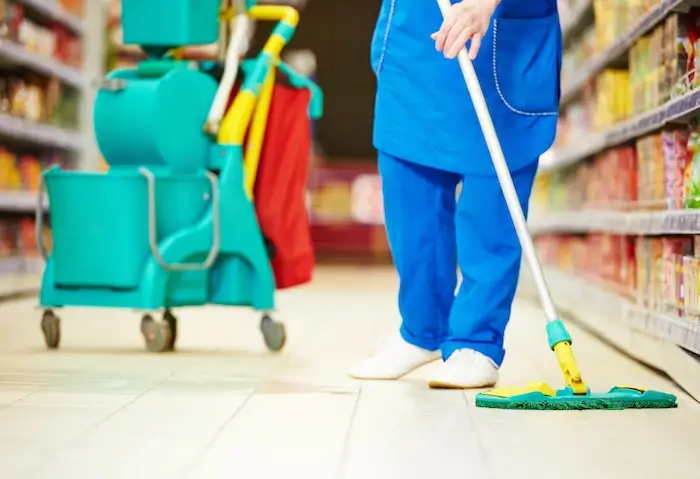
Large hard-floor areas taking constant cart and foot traffic, with spills that have to be dealt with immediately for safety rather than at the end of a shift. Autoscrubbing keeps the aisles presentable; the real work is the edges, corners and the strip under gondola ends that a machine cannot reach.
Produce
Constant organic debris, standing water around misted displays, and the slip risk that comes with both. Drains, display bases and the floor immediately around them need attention every day, not weekly.
Deli, bakery and prepared foods
Grease, flour, sugar and protein residue on floors, walls and equipment exteriors, plus food-contact adjacency that raises the standard. These areas need degreasing rather than general mopping, and floor drains need proper attention because that is where odor complaints originate.
Meat, seafood and coolers
Cold, wet and unforgiving. Case exteriors, gaskets, cooler floors and drains need a sanitizing routine and consistent attention to drainage, because water that never fully leaves becomes a smell and then an inspection finding.
Front end and customer areas
Checkout lanes, belts, terminals, cart corrals, entrance vestibules and restrooms. High-touch, high-visibility, and in a Buffalo winter the vestibule takes the full salt and slush load for the whole store.
Back-of-house and receiving
Stockrooms, receiving docks, compactor and baler areas, and trash rooms. Nobody sees them and they drive both pest pressure and odor, which means they are usually where an inspection problem actually starts.
Working around store hours
Most grocery cleaning is overnight or early morning between the last shopper and the first delivery. That window is short and it is fixed, so a crew that cannot finish inside it is not a fit. We scope the work to the window you actually have and, where a store trades late or around the clock, work zone by zone so no aisle is closed for long.
Floor care for high-traffic retail
Grocery hard floors take more abuse than almost any other commercial surface. We match the program to the material: autoscrubbing on a routine cycle, machine detail on edges and corners, and periodic restorative work such as scrub-and-recoat or burnishing where the floor is finished. Entrance matting is maintained deliberately, because in winter it is the only thing between road salt and the whole sales floor.
Supporting food safety without overstating our role
We are the environmental cleaning contractor, not the food safety program. What we can do is make the building support yours: floors and drains that do not harbour residue, back-of-house and trash areas that do not invite pests, restrooms that pass a walkthrough, and documentation of what was cleaned and when. Food-contact surface sanitation stays with your trained staff under your own procedures.
Request grocery store cleaning
Call (716) 444-3622 or send a message with the store size, the departments in the building and your available overnight window.
More about this service
What does cleaning a supermarket floor drain actually involve?
Lifting the grate out and brushing the drain body by hand. The residue that matters sits on the vertical walls above the water line, where splashing puts it and where poured liquid runs straight past it, so anything thin enough to pour out of a jug is gone before it can do any work.
There is a second failure that has nothing to do with residue. The trap is the U-shaped bend below the drain that holds a small pool of water, and that pool is the only barrier between the room and the sewer line. In a drain that rarely gets used, a back stockroom corner or the floor under a case that was pulled out years ago, the water evaporates and the barrier is gone. The fix there is water, not chemical.
A drain that is genuinely being cleaned goes something like this:
- Lift the grate out and soak and brush it separately. The underside of a grate holds more residue than the opening it covers.
- Pull the strainer basket where one is fitted, empty it into the trash and scrub it, rather than rinsing it in place and sending the debris down.
- Brush the throat and the body walls from the top down with a stiff drain brush long enough to reach past the visible lip.
- Use a foaming or enzyme product that clings to a vertical surface, instead of a thin liquid that drains away in seconds.
- Refill dry traps with clean water, and keep a written list of which drains go dry so they get topped up on a schedule instead of rediscovered by smell.
The grout and floor immediately around the drain lip take the same treatment, because they hold the same residue. Where the finish itself has gone porous and stopped releasing soil, that is a floor care problem rather than a drain problem.
How is cross-contamination controlled between departments?
By tying equipment to a zone and keeping it there. A mop head, bucket or cloth that cleans a restroom, a trash room or a compactor pad carries that soil to the next surface it touches, and in a food retail building the next surface should never be a produce display base or a deli floor.
Color coding is the simplest way to hold that line on a night crew moving quickly through a quiet store. One color for restrooms and trash areas, another for food departments, another for general sales floor and offices, applied to mop heads, cloth packs, buckets and brushes so a mistake is visible from across the aisle instead of discovered later.
Two habits matter as much as the color itself:
- Change the solution between zones instead of carrying one bucket through the building. Cleaning solution only works while it is still cleaner than the floor.
- Launder or replace mop heads and cloths on a set cycle. A mop head put back in a closet wet does not start the next shift clean.
The same separation applies to detail tools that are easy to forget, including grout brushes, drain brushes, scrapers and squeegee blades, which spend their working life in exactly the soil you least want moved somewhere else. This zoning runs through our commercial and janitorial cleaning work generally, but a grocery building is where it earns its keep.
How is a receiving dock and compactor area cleaned?
Dry pickup first, degreasing second, and the water removed rather than left to find its own way out. Doing it in the other order is why a dock that gets hosed regularly can still smell.
Corrugated cardboard drives most of the work. It arrives damp or becomes damp, it sheds fines and dust every time a bale is made, and its flutes hold both moisture and whatever traveled in on the pallet. Sweep up cardboard fines and cut baler wire before any water goes down, because wet pulp packs into floor seams and into the dock plate gap and stays there.
- Degrease the compactor pad and the chute surround rather than rinsing them, since rinsing without squeegeeing to a drain just spreads sugar and juice residue into a wider film.
- Clean the pit lip and the seam where the compactor meets the building, which is where liquid from beverage and produce loads collects and sits.
- Keep pallets, totes and bales off the wall so the perimeter can be swept and inspected instead of guessed at.
- Finish the trash room floor dry, because water left standing overnight undoes the cleaning that came before it.
Racking uprights, pipe runs and light fixtures above a stockroom shed onto everything below them, so overhead and high angle dusting is worth putting on a periodic cycle rather than leaving out of the scope and cleaning the same floor twice.
How does a night crew work around overnight stocking?
By finding out at the start of the shift which aisles are being stocked or reset, and cleaning those last. Overnight stocking crews are on the same floor with pallet jacks, u-boats and cut cases, so a machine running down an aisle that is being worked either blocks the crew or cleans a floor that is about to be covered in shrink wrap, box cutters and cardboard.
What that looks like once the shift is underway:
- Talk to the night lead before starting, not after a conflict. Which aisles are live tonight changes the order of everything else.
- Put wet floor signage out while a section dries and pick it up once it is dry. Signs that live on the floor permanently stop meaning anything to anyone.
- Leave the vestibule, front end and restrooms until the end of the shift so they are fresh at open rather than already walked through.
- Leave a short written handover for the day team covering anything skipped, blocked by a pallet, or found broken, so the morning manager is not guessing what happened.
That last point covers defects as well as cleaning. A case leaking onto the floor, a cracked tile, a drain backing up or a door sweep that no longer touches the threshold gets written down and handed over rather than quietly worked around, since the crew on the floor at 3 a.m. is often the only person who sees it. Every store's overnight traffic is different, so the sequence is worth agreeing on before the first night: talk to RTJ about an overnight cleaning schedule.
Supermarket and Grocery Store Cleaning questions
More answers on the FAQ page.
When do you clean a grocery store?
Usually overnight or early morning, between the last shopper and the first delivery. For stores that trade late or around the clock we work zone by zone so no aisle is closed for long.
Do you clean deli and bakery areas?
Yes. Floors, walls, drains and equipment exteriors in deli, bakery and prepared-food areas are cleaned with degreasing appropriate to the residue. Food-contact surface sanitation remains with your own trained staff.
Do you handle back-of-house and receiving?
Yes. Stockrooms, receiving docks, compactor and baler areas and trash rooms are included. These drive pest pressure and odor and are where inspection problems usually begin.
Can you help with a health inspection?
We can make the building support your program: floors, drains, back-of-house, restrooms and documentation of what was cleaned and when. We are the cleaning contractor, not the food safety program itself.
How often should supermarket floor drains be cleaned?
It depends on the department. Drains in produce, deli, bakery, meat and seafood benefit from a grate check and flush on the nightly routine, with a full brush-out of the basket, throat and body walls on a recurring cycle agreed with the store. Dry-side drains in stockrooms and back corners need far less scrubbing, but they do need water added regularly so the trap seal does not evaporate and open a path for sewer gas into the room.
Why does a grocery store still smell after the floors are mopped?
Because mopping moves water across a surface and does not remove the source. The usual sources sit off the floor plane: film on the drain walls above the water line, a trap that has dried out, damp cardboard in receiving, a saturated entrance mat, or mop water that was not changed often enough and is redepositing soil rather than lifting it. Finding the source beats covering it with a scented cleaner.
Will your crew move product, pallets or displays to clean under them?
No. We clean around stocked product and loaded pallets and do not move merchandise. If you want the floor under a display, pallet or movable rack cleaned, your team moves it or schedules it during a reset, and we work that area into the same night. Fixed equipment is cleaned around and under to the extent it can be reached safely.
How are walk-in freezer floors cleaned?
With low-moisture methods, because anything left behind refreezes into a slip hazard rather than drying. That generally means scraping and sweeping debris out first, spot cleaning with a product rated for use at freezer temperatures, and extracting or wet-vacuuming immediately instead of leaving a squeegeed film to freeze. It is scheduled when stock is low enough to work safely, and product and food-contact surfaces inside the space stay with your own staff.
Ready for a quote?
Call (716) 444-3622 or send us the details of your building.