Water Damage Restoration and Flood Water Removal in Buffalo, NY
Water spreads faster than most building owners expect. It wicks up drywall, travels under vinyl and carpet tile, and reaches wall cavities and insulation long before the floor looks wet. RTJ Enterprise Cleaning Company handles water removal, drying and post-water cleanup for commercial and residential properties across Buffalo and Western New York.
Why the first day decides the cost
A burst supply line, a failed water heater, a roof leak or a backed-up drain does most of its damage in the hours nobody is watching. Standing water keeps moving: into the subfloor, along the underside of carpet backing, up the paper face of drywall by capillary action. Materials that could have been dried and saved on day one often have to be cut out and replaced by day three.
That is why the first call matters more than any single piece of equipment. Getting water out and airflow in quickly is usually the difference between drying a building and rebuilding part of it.
What we handle
Emergency water extraction
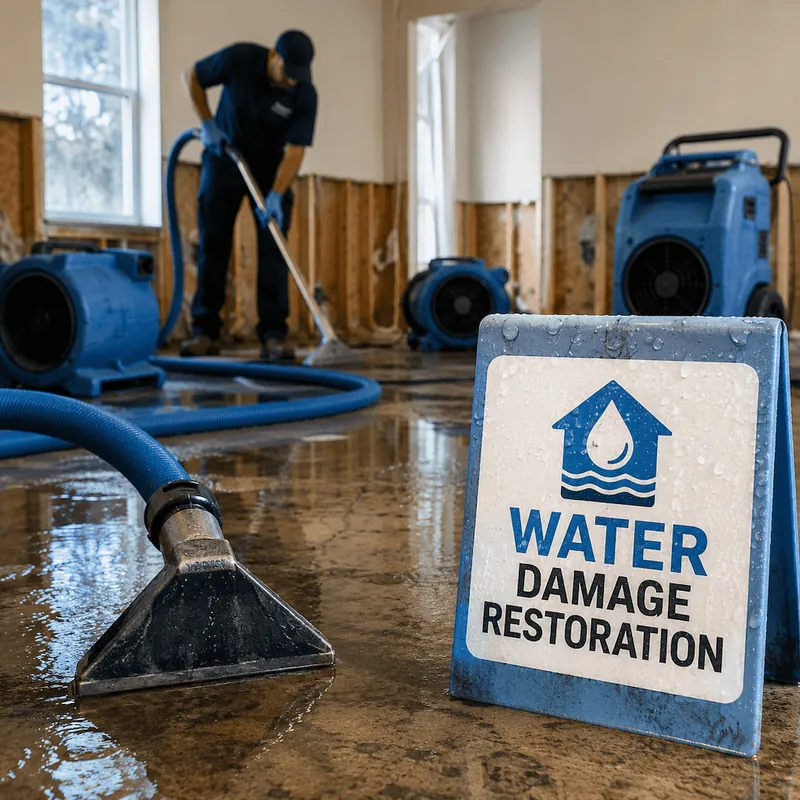
Standing water is pulled off hard floors and out of carpet and pad with extraction equipment rather than mops and buckets. On carpet, extraction is repeated as the pad releases water it was holding, which is the step most often stopped too early.
Flood water and bulk removal
Where a space has taken on volume, from a storm event, a sump failure or a broken main, we remove the water and then the debris and unsalvageable materials it leaves behind, so the structure can be assessed dry.
Structural drying and dehumidification
Air movers are positioned to move air across wet surfaces, not just around the room, and dehumidification pulls the released moisture out of the air instead of letting it redeposit somewhere colder. Drying is monitored to a target rather than run for a fixed number of days and hoped for.
Sanitizing and odor control
Water from a drain, a sewer line or a flood is not clean water, and the surfaces it touched need cleaning and disinfecting once they are dry, not while they are still wet. This is the same discipline described on our disinfection services page: clean first, then apply an EPA-registered product and leave it wet for its full contact time.
Post-water cleanup and reinstatement
Once the building is dry, it still has to be made usable. That is ordinary cleaning work at an unusual scale: floor care to recover hard surfaces, carpet cleaning where the carpet was saved, and post-construction cleanup after any repair work, so the space is handed back finished rather than merely dry.
A straight answer about mold
Wet building materials that stay wet will eventually grow mold, so it comes up on almost every water job. New York State regulates this work: under Article 32 of the New York State Labor Law, mold assessment and mold remediation are licensed activities, and the same company is not permitted to both assess and remediate the same project.
So we are clear about the line. RTJ does the water side: extraction, drying, cleaning and the disinfection that keeps a dried building from becoming a mold problem in the first place. Where mold is already present and remediation is required, that work belongs to a New York licensed mold remediation contractor, and we will tell you so plainly rather than take work we should not.
Buildings we work in
- Offices and multi-tenant commercial buildings
- Medical, dental and clinical offices
- Retail floors, storefronts and service counters
- Warehouse, light industrial and flex space
- Supermarkets and food retail back-of-house
- Apartment and rental units between tenants
- Homes, finished basements and residential rentals
Working with your insurer
Most commercial water losses run through an insurance claim, and claims are settled on documentation. We record what was found, what was removed, what was dried and how long it took, and we photograph conditions before work starts. Whether a particular loss is covered is between you and your carrier, but the paperwork should never be the reason a claim stalls.
Water damage in a Western New York winter
A large share of the water losses in this region are cold-weather losses: pipes in unheated spaces, a supply line on an exterior wall, ice damming that pushes meltwater back under roofing, and sump pumps that fail during a fast thaw. The vulnerable spots are predictable, which means a walkthrough before winter is a cheaper conversation than the one after a pipe lets go over a long weekend.
Call as soon as you find it
Call (716) 444-3622 or send us the details. Tell us what the water came from, roughly how much of the space is affected and what is underfoot, and we will tell you what needs to happen first, including when the honest answer is that you need a different specialist.
More about this service
What are the three categories of water damage?
Water is sorted into three categories by how contaminated it is, and the category changes how the water and the materials it touched are handled. Category describes contamination, not volume. A small backup from a drain line is handled more carefully than a much larger clean-water leak.
| Category | Where it comes from | What it changes about the work |
|---|---|---|
| Category 1, clean water | A broken supply line, a failed water heater, an ice maker line, a fixture overflow with nothing added to it | The work is essentially a drying job. The water itself needs no special handling. |
| Category 2, gray water | Discharge from a dishwasher or washing machine, sump discharge, water that has run through soil or building materials | Every surface the water reached is cleaned as well as dried, and absorbent materials are evaluated rather than assumed salvageable. |
| Category 3, black water | Sewage, a backup from past the trap, storm water that ran across the ground | The water is treated as a health hazard. Containment, worker protection and contaminated-waste disposal become part of the job. |
Category is judged at the time the work is done, not at the moment the pipe broke. Clean water that has sat warm in a dark cavity picks up soil and organic material from whatever it is touching, so a loss found late is often no longer a category 1 loss.
The use of the room raises the bar independently of the category, which is why the same category 2 loss is handled one way in a warehouse aisle and another way in a medical or clinical space where surfaces have to be returned to a clinical standard.
What is the difference between water category and water class?
Category is how dirty the water is. Class is how much material got wet and how hard that material will be to dry. Two losses in the same category can need completely different equipment because they are different classes.
- Class 1: the smallest amount of wet material, mostly low-porosity surfaces such as sealed concrete, tile or plastic. Little water was absorbed, so the room gives it up quickly.
- Class 2: a whole room of carpet and pad, or wicking up walls under roughly two feet. A large volume of absorbed water in materials that release it readily.
- Class 3: water that arrived from above, so ceiling, walls, insulation and the entire floor are wet. This is normally the largest evaporation load in a building.
- Class 4: water held in materials that let go of it slowly, such as hardwood, plaster, masonry and concrete. These need low humidity and time rather than more airflow.
Class is what determines how many air movers and how much dehumidification a space genuinely needs. It is also why a number quoted from square footage alone tends to be wrong: a class 4 room half the size of a class 2 room can take considerably more equipment and considerably longer.
What do a moisture meter and a hygrometer actually measure?
They measure two different things, and a drying decision needs both. A moisture meter reads moisture inside a material. A hygrometer reads moisture in the air.
- Pin meter: two probes are pushed into the material and the tool measures electrical resistance between them. Wetter material conducts better. It gives a definite reading at a definite depth and leaves two small holes.
- Pinless meter: a sensor pad reads through the surface using an electromagnetic field, roughly an inch deep depending on the tool. Nothing is punctured, which makes it the practical way to scan a large floor and find where the wet area actually ends rather than where it appears to end.
- Thermo-hygrometer: reads temperature and relative humidity together, which gives dew point and the actual weight of water the air is carrying. Relative humidity on its own is misleading, because the same reading in a cold room and a warm room represents very different amounts of water.
Readings are compared, never read in isolation. A dry area of the same material elsewhere in the building is measured first, so there is a known dry number for that material, in that building, in that weather, to measure the wet areas against.
When does drywall get cut out instead of dried in place?
Drywall is dried in place when the readings say it will dry in a reasonable time and the water was clean. It is cut when it will not dry in a reasonable time, or when the water was not clean.
A flood cut is exactly what it sounds like. The wall is cut horizontally above the visible wet line, usually a foot or two off the floor, so the wet wallboard and the wet insulation behind it come out and the cavity can be opened up and dried.
What pushes a job toward cutting:
- Category 3 water, or category 2 water that soaked into insulation
- Wet fiberglass or cellulose insulation, which holds water and dries very slowly inside a closed cavity
- Water that sat long enough for the paper face to soften, bubble or lose its bond to the gypsum core
- Plaster, or two layers of wallboard, where no practical amount of airflow reaches the wet side
- No workable way to get air into the cavity, and readings that are not falling between visits
A cut line also serves the repair. It gives a straight edge to patch back to, and it is the only way anyone actually sees the inside of the cavity, including whether the insulation is wet and whether the bottom plate is holding water.
What belongs in a drying log?
A drying log is the daily written record of conditions, readings and equipment for a drying job. It is only useful if the same measurements are taken at the same places on every visit, because numbers from scattered locations on different days cannot be compared to each other.
A useful log carries, for every visit:
- Date, time and who took the readings
- Outside temperature and relative humidity, since the outdoor air sets what the equipment is working against
- Temperature and relative humidity in each affected room
- The same two readings taken in a dry, unaffected area used as the control
- The temperature and humidity of the air coming out of each dehumidifier, which is how you tell a working unit from one that is merely running
- Moisture content readings from marked, numbered spots rather than wherever the meter happens to land
- Equipment on site: how many air movers and dehumidifiers, where each one is, and anything added, moved or shut down
The marked-spot detail is the one that does the work. It means the reading from day one and the reading from day four describe the same square foot of the same material, which is the only way the two numbers mean anything next to each other.
Can a business stay open while a space dries?
Usually part of it can. Drying equipment is loud, warm and power hungry, so what stays open depends on how well the wet zone can be closed off from everything else.
Practical points worth settling before the equipment goes in:
- Electrical load. Air movers and dehumidifiers draw real current, and several units on one 15 or 20 amp circuit will trip the breaker. Equipment gets spread across circuits deliberately, and a building with limited panel capacity may need fewer machines running longer.
- Cords and walkways. Cords crossing a path people use are a trip hazard. They get routed along walls and taped down, and any doorway or exit that has to stay usable is planned around before day one.
- Containment. Plastic sheeting around the wet area is not decoration. A smaller sealed volume dries faster on the same equipment, and it keeps noise, dust and debris off the working side of the building.
- The side that stays open still needs its routine. Foot traffic around a work zone tracks in more than usual, so commercial and janitorial cleaning and normal office cleaning generally continue right through the dry-out rather than pausing until it is over.
Which rooms stay in use is a decision made at the start, alongside where the containment goes and which circuits the equipment lands on. It is much harder to rearrange on day three.
Water damage questions
More answers on the FAQ page.
How fast do you need to start after water damage?
As soon as the water is found. Extraction and airflow in the first hours are what decide whether materials dry out or have to be replaced, because water keeps wicking into drywall, subfloor and wall cavities the whole time it sits.
Can wet carpet be saved?
Sometimes. Clean-water losses caught early can often be extracted, dried and cleaned in place. Carpet soaked by drain or sewer water, or carpet that has stayed wet for days, usually has to come out along with the pad. We will tell you which situation you are in rather than dry something that should be replaced.
Do you handle mold remediation?
No. In New York, mold assessment and mold remediation are licensed activities under Article 32 of the State Labor Law. RTJ handles water extraction, structural drying, cleaning and disinfection. Where mold remediation is required we will say so and it goes to a New York licensed mold remediation contractor.
How long does drying take?
It depends on how much water went in, what materials absorbed it and how well the space holds conditioned air. Drying is monitored to a moisture target rather than run for a set number of days, so the honest answer comes from readings on site, not from a number quoted over the phone.
Will you work with my insurance company?
We document the loss thoroughly: what was found, what was removed, what was dried and how long it took, with photographs from before work starts. Coverage itself is a matter between you and your carrier.
Do you clean the building afterward, or just dry it?
Both. Drying is only half the job. Once the structure is dry we handle the cleanup that makes the space usable again, including floor care, carpet cleaning and cleanup after any repair work.
What is a flood cut?
A flood cut is a horizontal cut across drywall above the wet line, usually one to two feet off the floor, so the wet wallboard and the insulation behind it can be removed and the wall cavity opened up and dried. It is used when drywall will not dry in place in a reasonable time, or when the water that reached it was contaminated.
Is water from a fire sprinkler treated as clean water?
Not automatically. Water in a wet sprinkler system has been standing in steel pipe for years and carries scale, rust and pipe sediment, and some dry and antifreeze systems contain additives that are not simply water. Sprinkler discharge is judged by what it picked up sitting in the pipe and by what it ran across on the way down, not by the fact that it started as potable water.
Can hardwood flooring be saved after a water loss?
Sometimes, and it depends on how long it stayed wet and what is underneath it. Wet boards swell across the grain and cup, meaning the edges rise above the center. Caught early and dried properly, cupping often relaxes as the moisture content evens out through the board, and the floor may only need sanding and refinishing once it is fully dry. Boards that stayed wet long enough to buckle, or that have released from the subfloor, generally come out.
What is a moisture map?
A moisture map is a simple drawing of the affected area with the wet boundaries marked and the reading locations numbered, so the same numbered spots are measured on every visit. It answers a question a written note cannot: how far the water actually traveled, including under flooring and into cavities, and exactly where to put the meter next time.
Found water? Call now.
The first hours matter most. Call (716) 444-3622.