

Office Cleaning in Buffalo, NY
Office cleaning is the quietest part of running a workplace until it stops working. Then it is a full recycling bin at a client meeting, a break-room sink nobody will touch, and a restroom complaint in the staff survey. RTJ keeps Buffalo and Western New York offices consistently clean on a nightly or weekly cycle so it stays invisible.
A typical office cleaning scope
Workstations and open plan
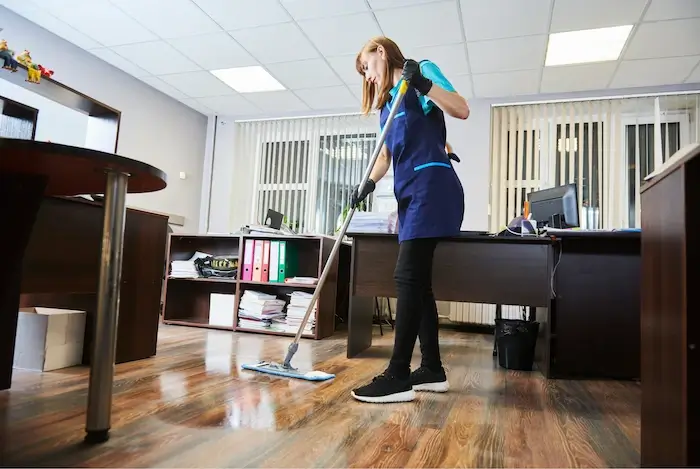
Desks are dusted around personal items rather than through them, monitors and keyboards get a light dry pass, chair bases and pedestals are wiped, and floors are vacuumed or dust-mopped edge to edge including under desks where cable trays collect dust.
Break rooms and kitchens
Counters, tables, sinks, faucets and appliance exteriors are cleaned and sanitized, microwaves are wiped inside, refrigerator exteriors and handles are disinfected, and trash and recycling are pulled and relined. This is the room staff notice fastest, and the one most contracts underserve.
Restrooms
Fixtures are cleaned and disinfected, mirrors and dispensers are wiped, floors are mopped into corners rather than around them, and consumables are restocked. Restrooms are cleaned with dedicated, color-coded cloths that never travel to another area.
Conference rooms and common areas
Tables reset, glass and partition smudges cleared, chairs pushed in, and floors done. A conference room that is clean at 8am is the difference between a prepared meeting and a scramble.
Entrances, glass and high-touch points
Entry glass, door handles, push plates, light switches, elevator buttons, handrails and shared equipment such as printers are disinfected on every visit. In winter, entry mats and the first ten feet of floor get extra attention because that is where Buffalo salt lands.
Choosing a frequency
Five nights a week suits offices with high daily occupancy, client visits or shared kitchens. Two or three nights a week works for hybrid teams where the building is genuinely quiet on Mondays and Fridays. Once a week fits small professional suites, usually paired with a periodic deep clean. We would rather set the right frequency at the start than sell a five-night contract to a building that is half empty on two of them.
Hybrid offices and reduced occupancy
A lot of Western New York offices are still carrying a cleaning contract written for pre-hybrid headcount. If your building is genuinely emptier on certain days, the scope should reflect it, usually by reducing frequency in the workstation areas while holding restrooms and kitchens steady, because those do not scale down as neatly as desks do.
Security, keys and after-hours access
Cleaners are background checked before they work an account. Access is arranged around your procedures: keys, fobs, lockboxes, alarm codes or badging in through your own system. Crews are trained not to touch paperwork, screens or anything on a desk beyond what the scope requires.
Book office cleaning
Call (716) 444-3622 or send a message. We will walk the suite, ask how many people are actually in on a given day, and put a scope and frequency in writing.
More about this service
Why does an office still look tired when it is cleaned every night?
Because a nightly visit is a fixed route on a fixed clock, and the surfaces that dull an office slowly are not on that route. The nightly work belongs to the recurring commercial cleaning program. What follows is the office-specific list of what sits outside it, and what each item actually needs instead.
| Where wear shows first in an office | What a nightly route reaches | What the surface actually needs |
|---|---|---|
| Carpet edges, corners and the lanes under desks | Open floor and main traffic lanes | Edging along baseboards and under cable trays, plus periodic hot water carpet extraction |
| Hard floor finish in corridors and break rooms | Dust mop and damp mop, which keeps it clean but not restored | Scrub and recoat, or strip and refinish, on a set cycle (commercial floor care) |
| Supply vents, light diffusers, sprinkler heads and ledges | Nothing, since it is above working reach | Scheduled high angle dusting with proper access equipment |
| Door frames, kick plates, switch plates and partition fabric | A spot clean when a mark is visible | A full wash pass across the whole run, not just the marked spot |
| Fabric task chairs and soft seating in waiting areas | Chair bases and pedestals | Periodic upholstery cleaning, scheduled the way carpet is |
When you look at a proposal, check that these items carry actual dates or an interval rather than the phrase "as needed." An interval you can point at is the difference between periodic work that happens and periodic work that quietly never does.
What does a clear-desk policy change about office cleaning?
A clear-desk policy is an internal rule that staff leave their desktops empty at end of day, and it is the one thing that makes a full desk surface wipe possible. Without it, the cleanable area of a desk is whatever is not covered.
The policy comes from management, not from the cleaning contract. A cleaning company cannot create one, and a crew cannot enforce one. It tends to take hold in offices that already have a reason to lock documents away overnight, since the habit is half built.
A partial policy works fine. Apply it to the areas where it matters and leave normal practice everywhere else, but draw the boundary on a floor plan rather than describing it in an email. A floor plan is something a substitute cleaner can read on their first night; an email thread from six months ago is not.
What can a cleaning crew do about dishes and food left in a shared kitchen?
Very little, unless your office writes a rule first, because dishes and food are personal property and a cleaner has no way to tell what someone is saving.
- Dishes. Washing personal dishes sits outside a normal janitorial scope. A full sink also blocks the basin and the faucet, so those get skipped that night rather than cleaned around. If you want a nightly sink reset, it has to be written into the scope and announced to staff before it starts.
- Abandoned food and containers. A posted purge day works where a judgment call does not. Pick a recurring date, tell staff what it is, and anything left after that date goes. Until a date exists in writing, nothing personal gets thrown out.
- Coffee equipment. Carafes, drip trays and exteriors can be written into a scope. Brewer internals and descaling are equipment maintenance and normally stay with whoever services the machine.
The common thread is that a posted, written rule is what turns any of this from a favor into something a crew can actually carry out.
What is not included in a nightly office cleaning?
A cleaning scope covers surfaces, trash and floors, not building repairs, personal property, or equipment another vendor owns. The boundaries that catch people out are these.
- Moving things. Furniture, boxes and equipment stay where they are, and crews clean around anything heavy or plugged in.
- Cable management and workstation equipment. The tangle behind a desk belongs to whoever owns the hardware.
- Enclosed storage. Desk drawers, file cabinets and locked cabinets stay closed, both for privacy and because a cleaner has no way to know what matters inside one.
- Errands. Watering plants, handling mail and packages, and loading or unloading appliances are office tasks rather than cleaning tasks.
- Building maintenance. Bulbs, air filters, plumbing and HVAC are repair work. A cleaner can note a dark fixture or a slow drain and pass it to your contact, which is where it stops.
A second group is not excluded at all, just scoped and quoted separately: post-construction and renovation dust removal, floor refinishing cycles, overhead dusting, and cleanup after a plumbing or roof leak. Each one needs different equipment and a different amount of time on site, which is why it is priced on its own rather than folded into a nightly rate.
Trash and recycling: the decisions your building has to make
Recycling rules come from your hauler and your building, not from the cleaning crew, so the stream definitions have to be written down before the first night rather than guessed at nightly.
- What goes in which stream here. Buildings define recycling differently. Write down what your hauler actually accepts, because a contaminated load can be pulled from recycling entirely and sent to trash.
- Desk-side bins. Decide whether every bin is pulled every visit, or only when a staff member sets it out in the aisle. The set-it-out convention is common in offices where paper already goes to a shredding console.
- Confidential paper. Locked shredding consoles are usually emptied by the shredding vendor, not by the cleaning crew. Say so explicitly, or those consoles fill up while everyone assumes someone else has it.
- Cardboard. Note whether boxes are broken down and stacked, and where they go. In a multi-tenant building this is often a different location than the regular dumpster.
- The dumpster or compactor itself. Where it is, whether it is locked, and who holds the key or the code. A crew that cannot reach the dumpster cannot finish the trash run.
None of this is complicated, but each item is a place where two reasonable people assume opposite things. Settling it in the written scope costs one conversation and prevents the recurring version of it.
Office Cleaning questions
More answers on the FAQ page.
How often should an office be cleaned?
It depends on real daily occupancy. High-traffic offices with client visits usually need five nights a week; hybrid offices often do well on two or three, with restrooms and kitchens held at a steady frequency because those do not scale down with headcount.
Will cleaners go through papers on desks?
No. Crews are trained to clean around personal items and paperwork, not through them. If you want a desk left entirely untouched, that is noted in the scope.
Do you clean office kitchens and refrigerators?
Counters, sinks, tables, appliance exteriors and microwave interiors are standard. Full refrigerator interior cleanouts are scheduled periodically rather than nightly, usually monthly or quarterly.
Can you work around a hybrid schedule?
Yes. We can align service nights with your busiest in-office days rather than spreading the same frequency across a week that no longer looks like that.
Can an office be cleaned during business hours instead of after hours?
Yes, though it changes what gets done and when. Daytime service is usually a day porter arrangement, meaning a cleaner on site through the workday handling restrooms, the break room, entry glass, trash and spills as they happen. Vacuuming and floor work still tend to move to a quieter window because of noise and drying time. Some buildings run both: a day porter through the day and a full pass after close.
How should we report an area that was missed?
Through one named contact on your side, using a shared log or a single email thread so nothing gets lost in side conversations. Include the floor, the room and the date, because a specific note can be checked against the written scope while a general complaint cannot. If the same item keeps coming back, that usually points at the scope or the time on site rather than at the cleaner.
What is the difference between cleaning and disinfecting an office?
Cleaning removes soil and most of what lives in it; disinfecting kills germs remaining on a surface that has already been cleaned. Order matters, because a disinfectant sprayed over dust or grease is largely wasted. So does dwell time: the product label states how long the surface has to stay visibly wet for the claim to hold, and that is usually longer than the time it takes to wipe it dry. That is why high-touch points are handled as their own step rather than folded into the dusting pass.
What happens when a service night falls on a holiday or the office closes for a week?
Decide in advance whether the visit is skipped, moved to the next business day, or credited, and put the answer in the agreement instead of settling it the week it comes up. A multi-day closure is also the best window for periodic work such as floor refinishing or carpet extraction, since both need an empty floor and hours of drying time. Offices that plan around a scheduled shutdown get that work done without giving up a working day.
Ready for a quote?
Call (716) 444-3622 or send us the details of your building.