Hospital & Medical Facility Cleaning in Buffalo, NY
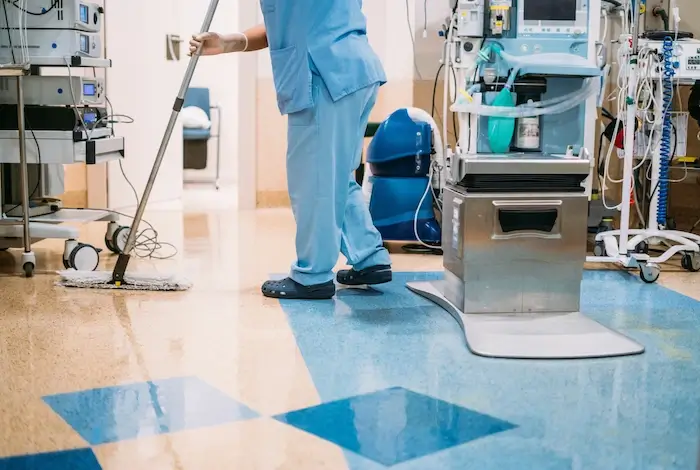
Healthcare space is cleaned to a different standard because the consequence of getting it wrong is different. RTJ cleans medical offices, clinics, dental practices, urgent care and outpatient facilities across Buffalo and Western New York using infection-control practice rather than general janitorial habits.
How medical cleaning differs
Clean to dirty, always
Work moves from the cleanest area to the dirtiest and never back. Within a room that means high surfaces before low, patient-contact surfaces before floors, and the restroom last. Reversing that direction moves contamination into the space that was just cleaned, which is the single most common failure in healthcare cleaning.
Color-coded microfiber, changed per zone
Cloths and mop heads are color-coded by zone and never cross between them. A cloth used in a restroom does not appear on an exam table, and cloths are changed between rooms rather than rinsed and reused. Soiled textiles go into a separate bag and are laundered, not wrung out in a bucket.
Disinfectant contact time is observed
Exam tables, chairs, counters, handles, rails, light switches and equipment surfaces are cleaned first and then disinfected with an EPA-registered product left wet for the full label contact time. On surfaces that dry too quickly we reapply.
Trained on what not to touch
Cleaners working healthcare accounts are trained on bloodborne pathogen awareness, on sharps and regulated medical waste boundaries, and on patient privacy. They do not handle sharps containers beyond agreed limits, do not move clinical equipment, and do not read or move charts, screens or paperwork.
Facilities we clean
- Physician offices and multi-specialty practices
- Dental and orthodontic practices
- Urgent care and walk-in clinics
- Outpatient, imaging and diagnostic centers
- Physical therapy, chiropractic and rehabilitation clinics
- Behavioural health and counselling practices
- Administrative and back-office space within healthcare buildings
Waiting rooms deserve their own scope
The waiting room is the highest-contact area in most outpatient facilities and the one patients judge the practice by. Chair arms, check-in counters, pens, clipboards, kiosks, door handles, toys where they exist and restroom fixtures are all high-touch and all get disinfected on every visit rather than dusted.
Documentation and accountability
Healthcare clients frequently need to demonstrate their environmental cleaning to an accreditor, an insurer or a corporate parent. We can provide records of what was cleaned and disinfected, when, and with which product, and we will work to a checklist you supply if your organization already has one it must satisfy.
An honest boundary
We clean outpatient and clinical office environments to infection-control practice. We are not a terminal-clean contractor for operating rooms or isolation rooms in an acute inpatient hospital, and we will tell you so rather than take work we should not. If your facility needs that level, we would rather point you correctly than learn it the hard way on your account.
Request medical facility cleaning
Call (716) 444-3622 or send a message with the facility type, the number of exam or treatment rooms and your preferred service window.
More about this service
What is a terminal clean, and how is it different from a daily clean?
A terminal clean is a full cleaning and disinfection of an entire room performed with the room out of service and empty, covering every surface rather than only the ones people touch. A daily clean is the routine visit that happens while the room stays in active use, and it concentrates on high-touch surfaces, waste, restocking and floors. The two are not levels of effort on the same task. They are different tasks with different triggers.
The table below is definitional, so you can tell the two apart when an accreditor, a landlord or another vendor uses the term. RTJ's healthcare scope sits in the daily-clean column, plus a scheduled deep rotation. We do not sell terminal cleaning.
| Aspect | Daily clean | Terminal clean |
|---|---|---|
| Trigger | Scheduled visit | End of a patient episode, or a room taken out of service |
| Room status | In use between and after appointments | Empty and closed until the clean is finished |
| Surface coverage | High-touch points, floors, waste, restrooms | Every surface in the room, including ones nobody touched |
| Above reach | Spot dusting | Vents, lights, tops of casework, curtain tracks |
| Soft goods | Usually untouched | Privacy curtains and fabric seating addressed or removed |
What most outpatient facilities actually want is neither of those in isolation. It is a daily clean plus a deeper room rotation on a cycle you set, so vents, curtain tracks, chair bases and floor edges get attention on a known schedule instead of whenever somebody notices. Hard-floor stripping and refinishing in clinical corridors is planned separately from either one, and our commercial floor care in Buffalo covers that work.
What actually makes a disinfectant fail on a surface that was wiped?
Most often the surface was disinfected before it was properly cleaned, so soil bound up the active ingredient before it could reach anything. The surface looks identical either way, which is why disinfection is a sequencing problem rather than a product problem. The failure modes worth knowing:
- Clean first, then disinfect. Organic soil and some detergent residues deactivate the active ingredient on contact. A visibly soiled surface needs two passes with two cloths, not one wet pass that tries to do both jobs.
- Label contact time is not one number. It varies by product and by the specific organism claimed on that label, from under a minute to several minutes. A crew that memorizes a single number and applies it to every bottle in the closet will be wrong on some of them.
- Quaternary ammonium binds to cotton. Cotton and some cloth blends absorb quat out of solution, so the concentration that lands on the surface is lower than the concentration in the bucket. Cloth material is part of the dilution, not just a matter of preference.
- Diluting a concentrate by eye is the quiet failure. Under-dilution wastes money and leaves film; over-dilution produces a product that no longer performs to its label at all. Metered dispensers or premeasured packets remove the guess.
- Product order matters on shared surfaces. Residue left by a general-purpose cleaner can interfere with the disinfectant applied over it. Rinsing or a dedicated cloth between steps prevents that.
Deeper disinfection work, including whole-space treatment after an outbreak or an exposure, is scoped through our disinfection services in Buffalo.
Who owns what between your infection prevention program and your cleaning contractor?
Your facility owns the infection prevention program and every clinical judgment inside it. The contractor owns consistent execution of the environmental cleaning tasks that program assigns, and the proof that they happened. Confusion over that line is where cleaning accounts go wrong, so it is worth setting in writing before the first visit.
- The facility decides which disinfectants are approved for its surfaces and equipment, and what the cleaning frequency needs to be for each room type. Those are clinical decisions, and a cleaning contractor should not be making them for you.
- The contractor executes the environmental scope: surfaces, floors, restrooms, waste removal to your designated point, restocking, and a documented sequence for each room type.
- Product substitution should require your approval. If an item on your approved list is out of stock, you should hear about it before anything else comes through the door. RTJ does not swap chemicals on a healthcare account without telling you first.
- Exceptions get flagged, not absorbed. A failing surface, a chronically empty dispenser, a soiled curtain or a room that was locked and could not be entered goes to a named contact rather than being quietly skipped.
If you do not yet have a written cleaning matrix, the workable starting point is a proposed scope by room type that your infection prevention lead reviews and approves, rather than a contractor deciding clinical frequency on its own.
What documentation should you be able to produce beyond the cleaning log?
The cleaning log is the part everyone expects. The records that actually get requested, and that facilities are least likely to have on hand, sit around it:
- A current label and safety data sheet for every product in use in the building
- Evidence that the products physically in the janitorial closet match the products on the approved list
- Dilution instructions wherever a concentrate is used, and a description of how dilution is controlled
- Training records for the staff assigned to your building, by topic and date
- An exception record: rooms not accessed, tasks deferred, and what was done about each
Two practical points. Training records only mean something when the same small group of cleaners is assigned to your building, because a rotating labor pool cannot produce a coherent training history for anyone to review. And an exception record with real entries in it reads as more credible than one that is perfectly empty, because it shows the reporting channel is live rather than decorative.
How does glove and hand hygiene practice differ from general janitorial work?
The physical work overlaps with general commercial janitorial. The glove discipline and hand hygiene do not. On a general account, gloves and closed shoes cover most of the job and a pair of gloves may last a shift. In clinical space, cleaners work on the assumption that any surface may be contaminated, which changes the routine in specific ways:
- Gloves are changed between rooms rather than worn through the building
- Eye protection is used whenever a product is sprayed or a splash is possible
- Gloves come off before touching a door handle, a cart, a phone or a light switch outside the room
- Hand hygiene follows every glove removal, not only the visibly dirty ones
One more difference has nothing to do with equipment. A spill involving body fluid is not handled like a spill of coffee. It has a defined containment, absorption, disinfection and disposal sequence, and improvising it is how a small incident turns into an exposure report. Any crew working clinical space should be able to describe that sequence before they are on your floor.
Administrative offices, break rooms and back-office areas inside a healthcare building are still part of the account. They can simply be scoped at a lower frequency than exam and treatment rooms, the same way we scope commercial cleaning in Buffalo, so you are not paying clinical-grade frequency for a copier room. To scope a facility, contact RTJ with your room count and room types.
Hospital and Medical Facility Cleaning questions
More answers on the FAQ page.
What does clean-to-dirty mean?
It is the rule that cleaning always moves from the cleanest area toward the dirtiest and never back: high surfaces before low, patient-contact surfaces before floors, restrooms last. It prevents contamination being carried into an area that was just cleaned.
Do you use color-coded cloths?
Yes. Microfiber cloths and mop heads are color-coded by zone, never cross between zones, and are changed between rooms rather than rinsed and reused.
Do you handle medical waste or sharps?
Not beyond agreed limits. Regulated medical waste and sharps handling stays with your own compliant process; our cleaners are trained on those boundaries.
Can you clean operating rooms or isolation rooms?
We clean outpatient and clinical office environments. We do not take terminal-clean work for acute inpatient operating rooms or isolation rooms, and we will say so rather than accept work outside our scope.
Is a terminal clean the same thing as a deep clean?
No. A terminal clean is tied to a room being taken out of service and covers every surface in that room after a patient episode ends. A deep clean is a scheduled intensification of routine work, such as detailing floor edges, vents, curtain tracks and casework on a rotation. Outpatient facilities usually need the second one on a cycle rather than the first one nightly.
Who is responsible for cleaning clinical equipment, your cleaners or our staff?
Your clinical staff. Anything that contacts a patient, or that carries a manufacturer reprocessing procedure, stays with your team because reprocessing is a clinical task with its own validated steps. Our cleaners handle the environment around it: counters, casework, chairs, handles, floors and waste.
What personal protective equipment do your cleaners wear in a clinical space?
At minimum, gloves changed between rooms and closed shoes, with eye protection whenever a product is sprayed or a splash is possible. Gloves come off before touching carts, doors or phones, and hand hygiene follows every glove change. Additional protection is used wherever your facility's own policy calls for it.
Do you clean during patient hours or after the practice closes?
Either, depending on the facility. Most clinical spaces are cleaned after close, because exam and treatment rooms are empty, no patient or chart is in the room to work around, and floors can be detailed without traffic crossing them. Some facilities also want a daytime presence for restrooms, waiting areas and restocking, which is scoped as a separate visit.
What happens if a room is locked or occupied when your crew arrives?
It is logged as an exception with the date and the reason and reported to your named contact, rather than marked complete. Depending on your scope it is either picked up on the next visit or scheduled for a return trip. Keeping those visible is what makes the rest of the cleaning record believable to anyone reviewing it.
Ready for a quote?
Call (716) 444-3622 or send us the details of your building.