
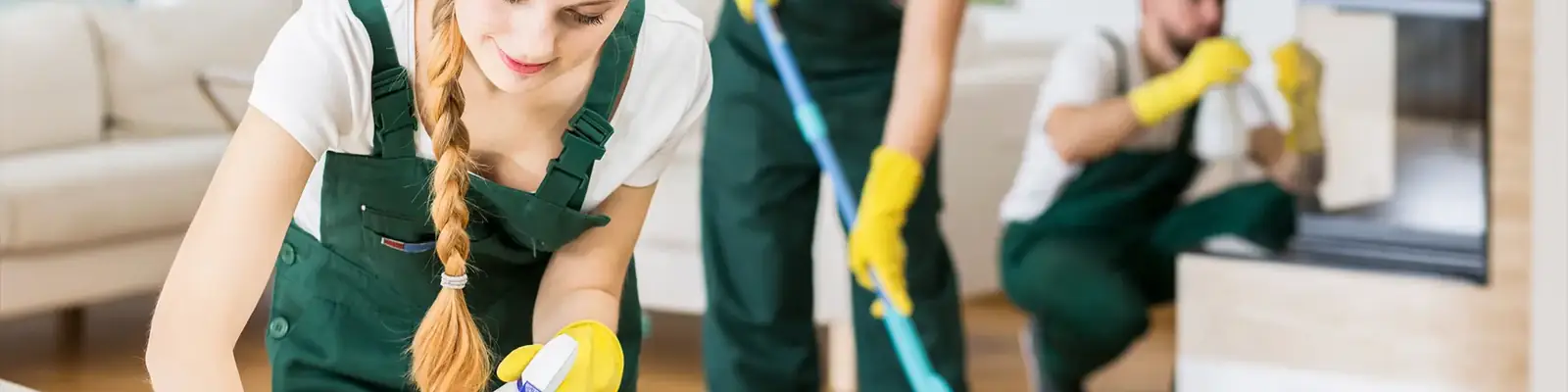
Commercial Floor Care in Buffalo, NY
Commercial flooring is one of the most expensive surfaces in a building and the one most often ruined by maintenance rather than by wear. RTJ provides floor care across Buffalo and Western New York matched to the material actually installed, because the routine that keeps VCT looking new will strip the finish off sealed concrete.
Floor types we maintain
VCT and vinyl composition tile
The workhorse of schools, clinics and back-of-house. VCT needs a maintained finish: routine scrubbing to remove soil, periodic burnishing to restore gloss, and a strip-and-refinish cycle when the finish is worn through rather than merely dull. Most VCT that looks bad has simply had too many coats abraded and never rebuilt.
Terrazzo and polished stone
Durable and expensive, and easy to damage with acidic or abrasive products. Terrazzo is maintained with neutral cleaners, appropriate pads, and either a protective finish or a diamond-polish program depending on how the floor was specified.
Sealed and polished concrete
Common in warehouses, breweries and modern retail. Polished concrete does not want a wax finish. It wants neutral-pH cleaning, autoscrubbing with the correct pad, and periodic re-densifying or guard application. Applying floor finish to it is a common and costly mistake.
Ceramic, porcelain and quarry tile
The tile is rarely the problem; the grout is. Grout lines are porous and hold soil that mopping just redistributes. Restorative work uses higher-pressure extraction and appropriate cleaners, and sealing the grout afterwards is what makes the result last.
Commercial hardwood and LVT
Both are moisture-sensitive and finish-specific. Hardwood is cleaned dry or barely damp with a manufacturer-appropriate product and recoated rather than flooded. Luxury vinyl tile is durable but the wrong aggressive chemistry will dull the wear layer permanently.
The service cycle
- Daily or nightly: dust mopping, spot cleaning and damp mopping with the correct dilution
- Weekly to monthly: machine scrubbing to remove soil the mop leaves behind
- Quarterly to semi-annual: burnishing or high-speed polishing on finished floors
- Annual or as needed: strip and refinish, deep restorative scrubbing, grout cleaning and sealing
Entry matting is the cheapest floor care there is
In Western New York the biggest threat to a hard floor is what walks in on a boot between November and April. Road salt is abrasive and hygroscopic, and it will haze a finish and etch some surfaces. Fifteen feet of properly maintained entry matting removes most of it before it reaches the floor, and it costs a fraction of an unplanned refinish.
Scheduling disruptive work
Strip-and-refinish takes a floor out of service while the finish cures. We schedule it overnight, over a weekend, or across a holiday closure, and in occupied buildings we can do it zone by zone so only one corridor or room is closed at a time.
Book floor care
Call (716) 444-3622 or send a message. If you know the floor type and roughly when it was last refinished, that helps; if not, we will identify it on the walkthrough.

More about this service
How can you tell a dull floor from a worn out floor?
Clean and burnish a small test patch. If the gloss returns, the finish is still there and the floor is only soiled or scuffed. If the patch stays flat and cloudy after buffing, the finish is gone in that spot, and more polishing will not bring it back.
The two conditions look nearly identical from standing height, which is why floors get treated for the wrong problem. A few minutes of looking closely tells you which one you have.
| What you check | Dull finish (soil or scuffing) | Wear-through (finish is gone) |
|---|---|---|
| Overall look | Even haze or grayish film across the whole area | Bright edges with a dull path down the middle |
| Where it shows | Everywhere, including under desks and behind doors | Traffic lanes, pivot points, in front of doors and machines |
| After burnishing a test patch | Gloss comes back | Stays flat, sometimes looks worse |
| Marks | Black scuffs sitting on top, they wipe or buff off | Fine scratches and soil sitting in the tile itself |
| Tile seams | Seams look filled and smooth | Seams and tile edges stand out as dark lines |
The best reference sample is already in the room. Compare a traffic lane to a protected square under a cabinet or behind a propped door. That untouched patch shows what the floor is supposed to look like, and how far the walked-on areas have drifted from it.
What do floor pad colors actually mean?
Pad color signals how aggressive the pad is: the lighter the color, the gentler the abrasive. It is a widely followed convention rather than an enforced standard, so the printed use on the box is the real authority.
- White: the softest, used for polishing and light buffing on finished floors.
- Red: light cleaning and spray buffing, gentle enough for routine use.
- Blue: wet scrubbing that lifts soil without cutting away the whole finish.
- Green: heavy scrubbing that removes finish along with the soil.
- Black and brown: stripping pads, built to take the finish down to bare tile.
- Natural fiber and specialty burnishing pads: made for high speed machines and matched to a specific finish, not to a general cleaning job.
Color is not the only variable. Machine speed, downward pressure, water volume and the condition of the pad itself all change how aggressive a given pad behaves. A pad loaded with dried finish stops behaving like a pad and starts behaving like sandpaper, which is why pads get rinsed, flipped and retired on a schedule in any commercial cleaning program worth paying for. If you ever want to know why a floor came back streaked or swirled, the pad that did the work usually answers it.
What is a scrub and recoat?
A scrub and recoat removes the top layer of finish along with the soil trapped in it, then lays fresh coats over the base coats that are still sound. Nothing goes down to bare tile, so the floor is out of service for hours rather than for a full rebuild.
Skipping it wastes much of the work that follows. Recoating on a schedule is what keeps the finish thick enough that the tile never takes the abrasion, and a building that recoats regularly needs the full strip far less often. A building that never recoats ends up running the heaviest, wettest, most chemically aggressive process available as its only form of maintenance, which is the costliest way to run the cycle.
Perimeters are where recoating goes wrong. Machines cannot reach corners, wall edges, doorways or the space under fixed equipment, so those areas get skipped by the scrub but still catch every new coat. Finish stacks up where nobody walks, then yellows, ridges and chips, and the room ends up with dark lanes down the middle and a pale crust around the outside. A recoat is only worth doing if the edges are cut in and detailed by hand as part of it.
Is it cheaper to maintain a floor or replace it?
Maintaining is almost always cheaper, because replacement is never just the price of the flooring. A replacement job also carries demolition and disposal of the old material, subfloor prep and leveling, moisture testing on slabs, moving furniture, racking or fixtures out and back, an initial finish build on the new material, and days when the space cannot be used.
Floor finish is sacrificial by design. That is the entire idea behind it: the coating is meant to take the abrasion, get worn down and be replaced, so the tile underneath does not. On a maintained floor, wear happens in the finish, which is a consumable. On a neglected floor, wear happens in the tile's own wear layer, and nothing restores that.
Replacement genuinely is the answer in a few cases: tiles lifting or curling from adhesive failure, moisture pushing up through the slab, the printed pattern worn off vinyl, or the same spots being patched again and again. Those are material failures, not finish failures, and no maintenance program reverses them. On a new installation the opposite is true and the first coats matter most, which is why protecting and sealing new flooring belongs in post construction cleanup rather than in the first year of routine cleaning.
What should a floor care quote spell out?
A floor care quote should name the product, the process and the downtime, not just a price per square foot. Two bids on the same floor can differ by half and still be describing genuinely different amounts of work, and the only way to see that is to ask what each one includes.
- The material, identified by name. VCT, terrazzo, polished concrete and LVT do not share a routine, so a quote that never names the floor has not been priced against it.
- Which finish, and how many coats. An initial build and a recoat are different coat counts, and traffic lanes and entryways normally get extra.
- Pads, machines and dilutions for each step. This is where the cost difference between two bids usually lives.
- Whether perimeters and edges are hand detailed. Ask directly, because it is the easiest thing to leave out of a low bid.
- Dry time before foot traffic, and cure time before heavy items return. These are two different numbers and both come from the finish manufacturer.
- Who moves furniture and fixtures, and who puts them back. Settle this before the crew arrives, not at 9pm on the night of the work.
- What triggers a strip instead of a recoat. Agree in advance on who inspects the floor and who makes that call.
If you are not sure what is installed or when it was last refinished, that is a normal starting point, not a problem. A walkthrough settles it. Contact RTJ and we will identify the floor and put the scope in writing before anything is quoted, whether the work stands alone or runs alongside nightly office cleaning.
Floor Care questions
More answers on the FAQ page.
How often should VCT be stripped and refinished?
It depends on traffic. Many buildings run a full strip and refinish annually, with scrubbing and burnishing in between. A low-traffic area can go longer; a school corridor or clinic entrance may need it more often.
Can you put floor finish on polished concrete?
You should not. Polished concrete is maintained with neutral cleaning, correct-pad autoscrubbing and periodic densifier or guard products. Applying a wax finish to it creates a maintenance problem that is expensive to reverse.
Why does my tile floor still look dirty after mopping?
Usually the grout. Grout lines are porous and mopping tends to move soil into them rather than out. Restorative cleaning with extraction, followed by sealing, is what fixes it.
Do we have to close the floor during refinishing?
That area, yes, while the finish cures. We schedule it overnight, on weekends or over a closure, and in occupied buildings we work zone by zone so only part of the space is out of service.
Does floor pad color mean the same thing for every brand?
Mostly, but not reliably. The light to dark scale, with white the gentlest and black the most aggressive, is an industry convention that most manufacturers follow, and the general order holds across brands. The exact grit and construction still vary, and specialty burnishing pads do not fit the scale at all. The printed use on the box, and the floor manufacturer's own guidance, override the color every time.
How long before furniture can go back on a newly refinished floor?
Foot traffic can usually return once the finish is dry to the touch, but the coating keeps hardening for days after that. Rolling heavy carts, chairs and equipment onto finish that has not cured yet leaves marks and tears that can only be fixed with another recoat. Dry time and cure time are two separate numbers published by the finish manufacturer, and we work to the ones for the product actually used on your floor.
Why do black scuff marks keep coming back so fast?
Usually the floor has too little finish left. Scuffs are marks left on the coating by shoe soles and cart wheels, and a floor with a full, properly built finish releases them during routine buffing. A thin coating both marks more easily and holds the marks tighter. Scuffing that returns in the same lane within days of being buffed out is often the first sign that area is due for a recoat.
Does a newly installed floor need finish before the space opens?
Usually yes. Most new resilient flooring arrives with a factory coating that is not a maintenance finish, and installers typically require a cure period before anything is applied over it. After that window the floor gets an initial seal and finish build, with extra coats in traffic lanes and entryways. Skipping this step means the first year of wear lands directly on the tile instead of on a coating you can replace.
Ready for a quote?
Call (716) 444-3622 or send us the details of your building.