
Post-Construction Cleanup in Buffalo, NY
Construction dust does not behave like ordinary dirt. Drywall dust is fine enough to stay airborne for hours, and it will keep settling onto surfaces you already cleaned if the work is done in the wrong order. RTJ handles post-construction cleanup across Buffalo and Western New York in the sequence the job actually requires.
The three passes
Rough clean
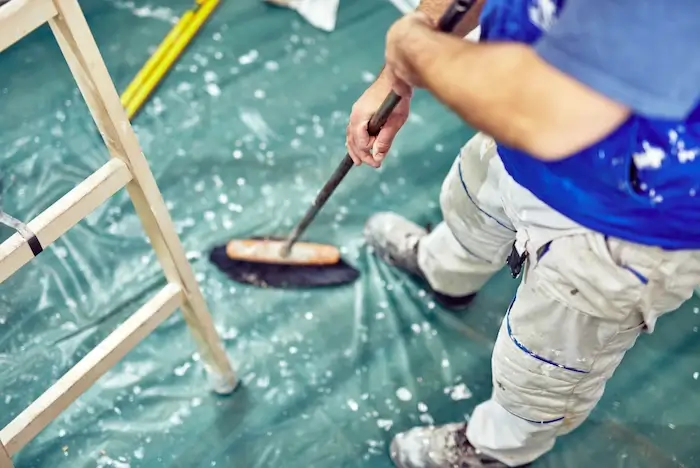
After framing and drywall, before finishes. Debris, offcuts, packaging and dust piles are removed, floors are swept and shop-vacuumed, and the space is made safe and workable for the trades still to come. This is the pass that determines how much dust the final clean has to fight.
Final clean
After the trades are out. This is the detailed one: top-down through the whole space so that anything dislodged from height falls onto surfaces not yet cleaned. Light fixtures, vents and diffusers, ledges, door tops and frames, then cabinetry inside and out, then fixtures and glass, then floors last.
Touch-up clean
Immediately before handover, occupancy or an open house. Fingerprints, scuffs from the last punch-list visits, fresh dust that settled overnight, and the glass everyone touched on the walkthrough. Short, and the one the client actually sees.
Why order matters more than effort
A crew that starts with the floors on a final clean will do the floors twice and still hand over a dusty space. Fine drywall dust that has been sitting on top of a door frame or inside a supply diffuser drops the moment anything disturbs it. We work ceiling to floor, and we vacuum with filtration rather than sweeping dust back into the air where it can resettle for the rest of the day.
What we handle
- Construction debris, packaging, protective film and stickers on fixtures and glass
- Fine dust on ledges, sills, door frames, trim, ductwork, diffusers and light fixtures
- Paint, adhesive, joint compound, grout haze and sealant residue on hard surfaces
- Cabinetry, millwork and closets cleaned inside and out
- Windows, glass partitions, mirrors and frames including tracks
- Restroom and kitchen fixtures brought to a finished state
- Initial floor treatment appropriate to the material installed
- Final vacuum of new carpet to lift installation fiber and dust
New floors need the right first clean
Freshly installed flooring is easy to damage with the wrong product. New VCT needs its initial finish handled correctly, sealed concrete and terrazzo have their own requirements, and a new hardwood floor scrubbed with the wrong chemistry can be a warranty problem on day one. We match the first clean to what was actually installed, and if the manufacturer specifies a break-in period we follow it.
Scheduling around a punch list
Construction schedules move. We would rather be told two days out that the final is slipping than show up to a space where the trades are still working, and we can stage a final and a touch-up around a realistic handover date. For occupied buildings under renovation we can also clean the live side of the barrier on a normal recurring schedule while the work continues.
Get a post-construction quote
Call (716) 444-3622 or send a message with the square footage, the type of build, and which passes you need. Plans or a walkthrough help us quote it accurately.
More about this service
Who is responsible for cleaning on a construction site?
Cleaning responsibility on a build is normally split three ways: the general contractor keeps the site safe and broom clean day to day, each trade removes its own material and packaging, and the cleaning contractor is brought in for defined passes rather than continuous site housekeeping. When that split is not written into the scope, it surfaces as a disagreement at handover.
Before we quote, we want to know which part is ours. A rough clean priced as dust and floor work becomes a different job if it also means hauling out a subcontractor's abandoned material.
| Party | Usually handles |
|---|---|
| General contractor | Dumpsters and haul-off, site safety, temporary power and lighting, protection of installed finishes, the punch list itself |
| Individual trades | Their own offcuts, packaging, spilled compound, overspray and adhesive from their own work |
| Cleaning contractor | The rough, final and touch-up passes as scoped, dust removal, detail work, first clean on new finishes |
| Owner or tenant | Furniture, stored goods, anything moved in ahead of handover |
Say so in the scope if you want us to bag and stage debris at a dumpster, remove floor protection, or wipe down owner-supplied fixtures. Those are reasonable additions, they just need to be priced. If the space is a tenant turnover rather than a build, what you probably need is a turnover clean, which is a different scope.
What is a punch-list clean?
A punch-list clean is the cleaning that follows the repair work on a punch list, not the cleaning that follows the trades leaving. A punch list is the written list of unfinished or defective items an architect, owner or general contractor produces after walking a nearly complete space.
The distinction matters because it is scoped and priced differently. A final clean is measured by area. Punch-list cleaning is measured by disruption: a painter cutting in three doors, a tile setter pulling and resetting one section, a mechanical contractor opening a ceiling to rebalance a diffuser. The size of the room says very little about how much cleaning that generates.
Two things keep this from becoming an open-ended cost. First, hold the punch work in as few visits as possible instead of letting it trickle over two weeks. Second, agree up front on how re-cleans are billed once the final has been accepted, whether by the hour, by the room, or by the visit.
How do dust barriers and negative air change the scope?
Containment reduces how much of the building has to be cleaned at all, and it moves the hard work into a smaller footprint. A dust barrier is a sealed partition, usually poly sheeting or temporary panels, separating the work area from finished or occupied space. Negative air means a filtered fan pulls air out of the work zone, so air leaks into the containment rather than out of it and dust does not drift down the corridor.
What that means practically:
- Without containment, dust travels on foot traffic and through the return air path, and the final clean quietly grows to include rooms nobody was working in.
- Barrier removal is its own event. Taking poly down shakes loose everything caught on it, and there is almost always a visible dust line on the floor where the bottom edge was taped. Schedule the final clean after the barrier comes down, not before.
- Air scrubbers and walk-off mats belong to the project, not to the cleaning crew. Tell us if we are expected to change mats or service filters, because that is a scope item rather than an assumption.
Why a final clean can fail an owner walkthrough
A final clean can fail a walkthrough for two reasons that have nothing to do with missed cleaning.
The first is inspection conditions. Owners walk with the permanent lights on and often in raking daylight, which reveals streaks on glass, swirl on new stainless and haze on polished floors that were invisible under temporary lighting. If the permanent lighting is not energized when we clean, tell us, because then we bring our own light to the detail work.
The second is the dust bloom that follows HVAC startup. When the system is started and balanced, filters loaded during construction push settled dust back out of the diffusers onto everything below. Filter replacement is a mechanical contractor scope item, but the timing has to be coordinated with the clean or the room dusts itself overnight.
The items that get written up are usually the ones above sightline: ceiling grid, stair nosings, sprinkler escutcheons and exposed structure. Anything above ladder height is a high angle dusting question, and someone has to own who supplies the lift.
What changes the price of a post-construction clean?
Square footage is the starting point, not the answer. Two spaces of identical size can price very differently depending on what was built and what condition it is turned over in.
- Number of passes quoted. Each pass is priced separately, so a single final and a three-pass sequence are different line items rather than different rates.
- Condition at turnover. A space the trades cleaned up behind themselves prices differently from one where compound buckets, offcuts and packaging are still on the floor.
- Glass and millwork count. Interior partitions, storefront, mirrors and cabinet interiors are detail hours, and they scale with quantity rather than with floor area.
- Height and access. Open ceilings, exposed ductwork and atrium glass mean ladders or lifts and a slower working pace.
- Finish type. The material installed sets the labor, so a floor schedule with several different finishes costs more to turn over than a single material throughout.
- Schedule. Nights, weekends and a compressed window between punch and occupancy mean more staff on site at once.
Send square footage, floor and glass types, the number of passes and a target handover date to request a quote, and we will scope it against what is actually there. Ongoing service after the building opens is quoted separately as recurring commercial cleaning.
Post-Construction Cleanup questions
More answers on the FAQ page.
What is the difference between a rough clean and a final clean?
A rough clean happens mid-project to remove debris and make the space workable. A final clean happens after the trades are out and is a detailed, top-down clean that brings the space to handover condition.
Why does construction dust keep coming back?
Drywall dust is extremely fine and settles slowly. If a space is cleaned bottom-up, dust dislodged from height lands on already-cleaned surfaces. Working ceiling to floor with filtered vacuums is what stops it.
Do you clean windows and remove stickers?
Yes. Protective film, manufacturer stickers, adhesive residue, glass, frames and tracks are part of a final clean.
Can you clean an occupied building during renovation?
Yes. We can run normal recurring cleaning on the occupied side of the barrier while construction continues, then handle the rough, final and touch-up passes on the work area.
Do you provide the dumpster and haul away construction debris?
Debris haul-off and the dumpster are normally arranged by the general contractor or owner, and we work to whatever container is on site. We can bag, gather and stage debris for removal as part of a rough clean, and we can quote haul-away separately if there is no container available. Tell us which arrangement applies before the visit so the crew brings the right equipment.
Who supplies ladders or a lift for high work?
We carry ladders for normal ceiling heights. Anything requiring a scissor lift, boom or scaffold needs the equipment supplied by the project, on site and available during our window. Open ceilings, atrium glass and exposed ductwork are the usual cases. Flag them at quoting, because access equipment affects both the price and how long the space is tied up.
Do you remove floor protection board before the final clean?
It can be included if it is written into the scope. Pulling protection board or hardboard is usually a general contractor task, and it matters because the floor underneath is rarely clean: tape residue, trapped grit and moisture marks are common. If we are removing it, we schedule the floor clean immediately afterward so the newly exposed surface is not walked on twice.
Can you handle mold, asbestos or lead paint discovered during a build?
No. Suspected asbestos, lead paint and significant mold are abatement work and belong with a licensed abatement contractor, not a cleaning crew. If our crew encounters something that looks like it, we stop work in that area and notify the site contact rather than disturbing it.
Do you clean exterior areas after construction?
Limited exterior work can be included, such as sweeping entry walks, clearing debris from an entrance apron, and cleaning exterior glass reachable from grade. Site grading, landscaping cleanup, roof debris and anything requiring lift access outside are separate and need to be quoted. Say what you need covered outside when you send the scope, since exterior work is weather dependent in Western New York.
Ready for a quote?
Call (716) 444-3622 or send us the details of your building.